
close
Choose Your Site
Global
Social Media
Views: 0 Author: Site Editor Publish Time: 2025-11-07 Origin: Site
PCBs shape how power circuits perform, affecting efficiency, heat, and EMI. A 2-layer PCB stackup can boost performance while controlling signal quality. In this guide, you will learn best practices for layout, trace width, and grounding to create reliable, cost-effective power PCBs.
A 2-layer PCB consists of a top and bottom copper layer separated by a dielectric, typically FR4. The top layer usually handles power traces and signal routing, while the bottom layer serves as a ground plane or secondary power path. Each layer plays a critical role in controlling voltage drops, EMI, and heat dissipation. Proper selection of copper thickness and dielectric material directly affects thermal performance and overall PCB efficiency.
Using a PCB layer design guide, engineers can plan trace widths, copper pours, and placement strategies to minimize resistance and maintain signal integrity. Consistent ground continuity and careful layer separation ensure noise reduction and reliable power delivery.
2-layer PCBs are particularly suited for low- to medium-power designs because they offer a balance between cost and performance. They simplify design, reduce prototyping time, and still provide adequate heat dissipation. For power electronics, these boards offer reduced EMI when ground planes are continuous and signals are carefully routed.
In addition, a power PCB layout tips approach encourages using wide copper traces for high-current paths, which enhances thermal management and prevents voltage drops. They are perfect for devices like LED drivers, motor controllers, and consumer electronics that do not require complex multilayer routing.
These boards are widely used in:
● LED lighting systems and drivers
● Battery-powered devices and portable electronics
● Motor controllers and power supply circuits
● Simple consumer electronics
Despite having only two layers, a well-designed PCB stackup can meet performance needs for many applications without the extra cost of multilayer boards.
Multilayer PCBs provide better support for high-density routing and EMI control but are more expensive and complex to manufacture. For simpler power circuits, a 2-layer board can handle current distribution, thermal dissipation, and signal routing effectively. Knowing when to opt for a multilayer versus a 2-layer PCB depends on circuit complexity and power requirements.
The top layer typically handles power traces, signal lines, and component placement. Designers often employ wide copper traces or large copper pours to manage high-current paths. SMD components, vias, and pads are strategically positioned for optimal routing and minimal voltage drop. Signal routing strategies, such as spacing high-speed traces from power traces, reduce crosstalk and EMI.
The dielectric, usually FR4, separates the copper layers and provides insulation. Its thickness and material properties affect both mechanical strength and thermal performance. Selecting the correct substrate helps balance board rigidity with heat dissipation, ensuring the PCB can handle power loads safely.
Layer | Function | Key Considerations |
Top | Power & signal routing | Wide traces, SMD placement, high-current paths |
Dielectric | Insulation & thermal control | FR4 thickness, Tg rating, mechanical stability |
Bottom | Ground & secondary power | Continuous plane, EMI reduction, optional split rails |
Solder Mask & Silkscreen | Protection & labeling | Prevent oxidation, improve assembly accuracy |
The bottom layer acts as a ground plane, ensuring a continuous return path for signals and minimizing EMI. Secondary power routing can be added if split rails are needed. Maintaining a solid ground plane improves overall circuit stability and simplifies component layout.
Solder mask protects copper from oxidation and shorts during soldering. Silkscreen labels components and indicates orientation, aiding assembly and troubleshooting. This layer ensures that components are correctly placed and reduces potential errors during manufacturing.
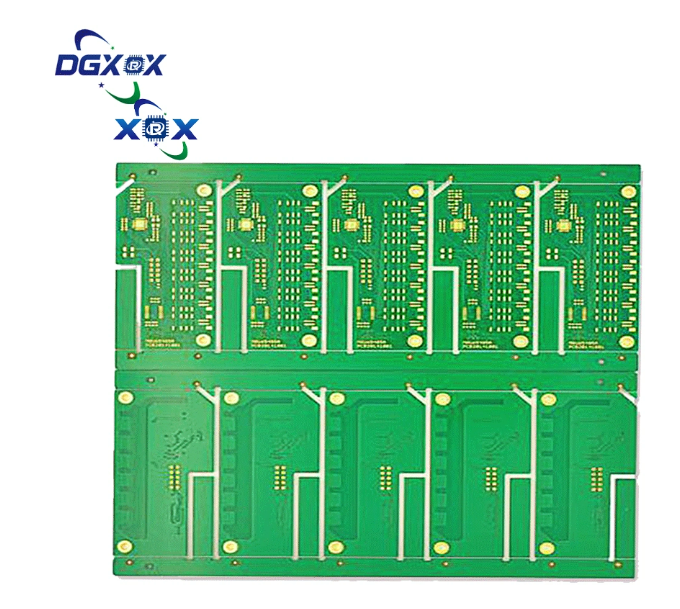
This stackup is the most common choice for low- to medium-power PCB designs, where power traces occupy the top layer and a solid ground plane resides on the bottom. It offers excellent EMI reduction, a stable reference for signals, and improved thermal dissipation. The clear separation simplifies routing for both surface-mount and through-hole components, reducing design complexity. Additionally, this configuration enhances voltage stability and supports high-current paths efficiently, making it ideal for standard power supply or motor control applications.
In this configuration, power and ground planes are distributed across both top and bottom layers. This approach reduces the number of required vias, lowers manufacturing costs, and provides flexibility for handling multiple voltage rails on compact boards. It is particularly advantageous when routing complex designs with limited board space. By balancing power distribution on both layers, designers can optimize current flow, minimize voltage drops, and maintain consistent thermal performance while keeping the PCB layout efficient and cost-effective.
For mixed-signal or high-density power circuits, both layers carry a combination of power and signal traces. Careful separation between noisy power lines and sensitive signal paths is critical to preserve signal integrity and prevent crosstalk. This configuration supports dense routing without sacrificing thermal performance or voltage stability. Designers must strategically implement spacing, shielding, and layer separation to maintain signal quality while accommodating complex routing requirements. It is ideal for advanced applications such as power management ICs, mixed-signal processing, or multi-rail systems.
Always place power and ground planes on separate layers to prevent interference and ensure effective signal return paths. Combining them increases electromagnetic interference (EMI) and can destabilize power delivery. A continuous ground plane not only stabilizes voltage levels but also provides a low-impedance return path for high-frequency currents. This practice enhances overall signal integrity, reduces noise, and improves the reliability of sensitive analog and digital circuits, especially in mixed-signal or high-current applications.
Trace width must be carefully calculated according to expected current and copper thickness. Wide traces minimize voltage drops, reduce resistive heating, and improve thermal reliability. Incorporating solid copper pours further distributes current evenly, preventing localized hotspots that can damage components. Properly sized traces are critical for high-power circuits, including motor drivers, power converters, and LED systems, ensuring efficient operation while maintaining long-term board durability.
Thermal vias placed beneath regulators, MOSFETs, and other high-temperature components significantly improve heat dissipation. These vias transfer heat from hot components to larger copper planes or secondary layers, enhancing cooling efficiency and preventing thermal stress. By reducing localized heating, thermal vias extend component life, improve reliability, and help maintain stable performance under continuous load conditions. Proper planning of thermal vias is crucial in compact or high-current designs.
Copper pours help distribute both heat and current more evenly across the board. They reduce electrical resistance, enhance thermal performance, and provide a continuous reference plane for signals, improving EMI behavior. Large copper areas act as heat sinks for high-current components while also facilitating stable voltage levels across power networks. Maximizing copper pour coverage is particularly beneficial in power supply circuits, motor drivers, and mixed-signal boards, contributing to both electrical efficiency and thermal management.
Minimizing loop lengths between power and ground reduces inductance, lowers noise, and improves overall power stability. Short, direct loops enhance circuit response to load changes, prevent voltage spikes, and maintain signal integrity. Proper loop management is essential for high-speed switching circuits, power converters, and sensitive analog designs, ensuring reliable operation and reducing susceptibility to EMI. Designers should plan routing carefully to keep loops compact while maintaining accessibility for components.
Placing too many components near high-current paths can lead to excessive heating and voltage drops, negatively affecting performance. Designers should provide sufficient spacing to allow heat to dissipate and maintain safe operating conditions. Adequate clearance also facilitates assembly, prevents shorts, and reduces mechanical stress on components, especially in compact or high-density designs. Strategic component placement is key to both thermal management and electrical reliability.
Using traces that are too narrow for the intended current load can result in overheating, voltage drops, or catastrophic board failure. Proper sizing should follow IPC-2221 standards or verified trace width calculators. Designers must consider copper thickness, expected current, and permissible temperature rise to ensure safety and longevity. Correct trace width is especially critical in high-current circuits such as power supplies, inverters, or motor drivers.
Failing to incorporate thermal relief, copper pours, or heat sinks can concentrate heat under critical components, reducing lifespan and reliability. Heat-sensitive parts may overheat, leading to performance degradation or failure. Early planning for thermal management, including copper pours, thermal vias, and proper pad design, ensures efficient heat transfer and prolongs board life, particularly in high-power or continuous-duty applications.
Interrupted or broken ground planes increase EMI, disrupt signal return paths, and compromise circuit stability. Continuous ground under sensitive signals provides a low-impedance path, reducing noise and maintaining signal integrity. Designers should prioritize uninterrupted ground coverage near analog, high-speed, or mixed-signal areas. Maintaining proper ground continuity improves overall power delivery, lowers crosstalk, and enhances both thermal and electrical performance.
Choosing the right substrate affects both performance and manufacturing cost. FR4 or equivalent materials are cost-effective and suitable for most low- to medium-power applications. Advanced substrates like Rogers offer improved thermal and electrical characteristics but increase production costs. Copper thickness must be selected to balance current capacity and heat dissipation. Optimal material choice ensures reliability without unnecessary expense, meeting both electrical and thermal design requirements.
Critical traces must maintain consistent impedance to prevent signal degradation, reflections, or EMI. Designers should prioritize routing of high-speed or sensitive signals while ensuring return paths remain clear and direct. Using ground pours or reference planes assists in impedance control, even in limited two-layer designs. Efficient routing not only improves signal quality but also reduces crosstalk and enhances board reliability under high-frequency operation.
Cost-effective designs reduce vias, optimize board thickness, and standardize materials. Fewer vias lower drilling time and decrease potential points of failure. Streamlined layouts simplify assembly, increase production yield, and are particularly advantageous for high-volume manufacturing. Optimizing board design from the start ensures a balance between performance, reliability, and overall cost efficiency.
Running simulations for thermal, EMI, and signal integrity prevents costly redesigns and ensures reliable operation. Validating current density, heat dissipation, and voltage drops allows designers to adjust copper pours, trace widths, and layout before production. Early detection of potential issues helps avoid hotspots, voltage instability, or noise problems, ensuring the PCB performs as intended under all expected operating conditions.
A 2-layer PCB stackup offers cost-effective and efficient power solutions. Proper layer design, thermal management, wide traces, and solid grounding ensure stable operation. Dongguan Xinrongxing Technology Co., Ltd. provides high-quality PCBs that enhance performance and reliability, delivering value for LED drivers, motor controllers, and other devices.
A: A 2 layer PCB stackup for power uses top and bottom copper layers to route power and ground. It ensures efficient thermal management, EMI reduction, and stable power delivery for low- to medium-power devices.
A: A PCB layer design guide recommends placing power traces on the top layer and a continuous ground plane on the bottom. Proper layout reduces noise, improves thermal performance, and simplifies routing.
A: PCB thermal management techniques prevent overheating of high-current components. Using wide traces, copper pours, and thermal vias improves heat dissipation and prolongs device lifespan.
A: Benefits include cost-effectiveness, simplified design, improved EMI control, and reliable current distribution. Proper power PCB layout tips enhance overall efficiency and signal stability.
A: Use wide traces for high-current paths, maintain separate power and ground layers, and position thermal vias under hot components. Following a PCB layer design guide ensures reliable operation.
A: Multilayer PCBs are needed for high-speed, multi-rail, or complex circuits. A 2 layer PCB stackup for power suffices for low- to medium-power applications with straightforward routing.
A: Avoid narrow traces, overcrowded high-current areas, broken ground planes, and insufficient thermal relief. Applying power PCB layout tips ensures stability and prevents failures.
A: Yes, maintaining a continuous ground plane and proper layer separation in a 2 layer PCB stackup for power minimizes EMI and preserves signal integrity.
A: Use IPC standards or calculators considering current, copper thickness, and temperature rise. Correct sizing ensures reliable operation and efficient thermal management.


